SOICT 2026 · Under Review
MixiMotion: One-Step Text-to-Motion Generation via Asymmetric Set Distillation
† Corresponding author
Abstract
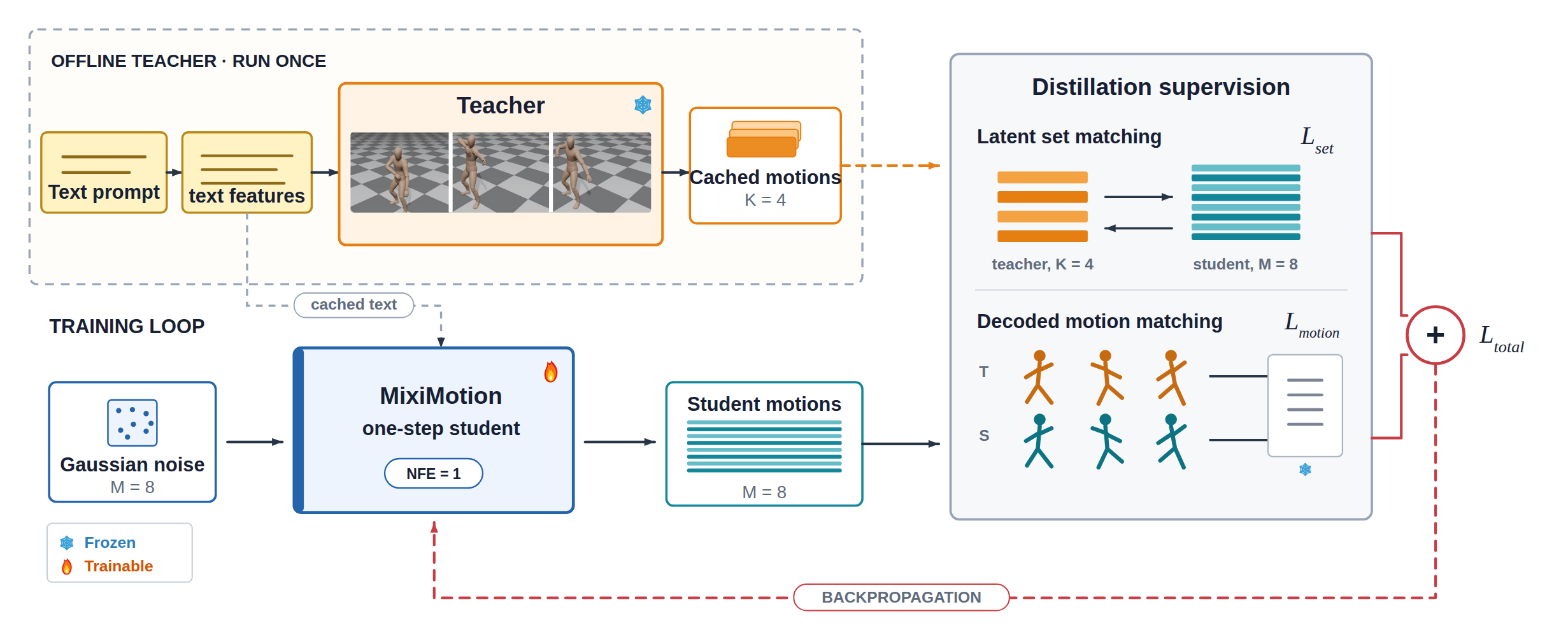
Diffusion and flow-matching models synthesize high-quality 3D human motion from text, yet iterative samplers require tens of network evaluations. Collapsing the sampler to one step is not a scheduling problem: one prompt admits many valid motions, so regression onto a single teacher sample averages modes, and latent residuals still decode into skating or root drift. We present MixiMotion, a strict one-step generator distilled from an offline teacher cache. A frozen multi-step model is run once per prompt to store several motion candidates; the student maps independent noises to one-step motions and is trained by asymmetric bidirectional set matching plus decoded kinematic constraints. The teacher is never queried during optimization. On ViMoGen, MixiMotion scores 0.880 versus 0.886 for the 50-step teacher under a shared renderer, at one network evaluation and 9.3 ms versus 830 ms on an RTX 5090.
Method Overview
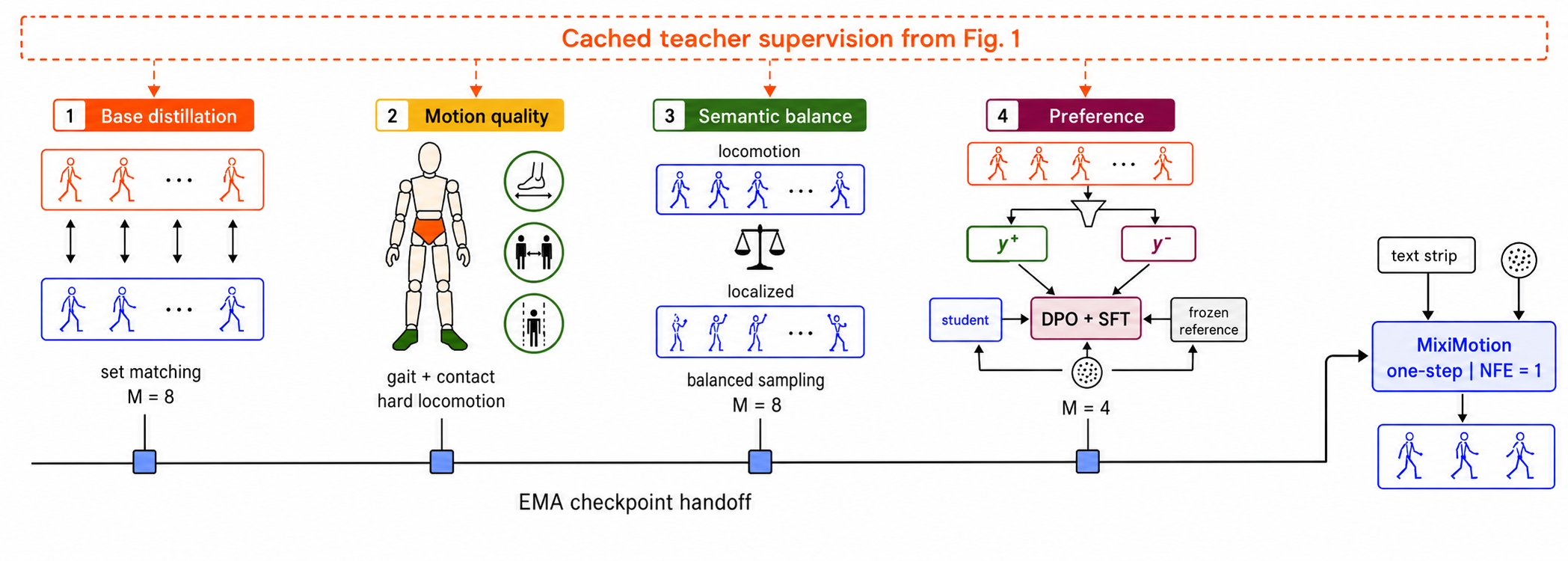
MixiMotion distills a frozen multi-step text-to-motion teacher into a strict one-step student using only an offline cache. Any multi-step generator that emits a motion sequence can serve as \(G_T\); any one-step map in the same output space can serve as \(G_\theta\). For each prompt we store \(K\) teacher motions, then train the student with asymmetric bidirectional set matching \(\mathcal{B}_{\boldsymbol{\alpha}}\) between teacher and student sets, plus decoded kinematic maps \(\Phi_r\) (contact, stride, root) after a frozen body decoder. Matching from teacher to student covers every cached target; the reverse direction penalizes unsupported samples. Optional staged reweighting and a heuristic ranking loss can be layered on the same bank. At inference the student uses one network evaluation.
Motion Samples
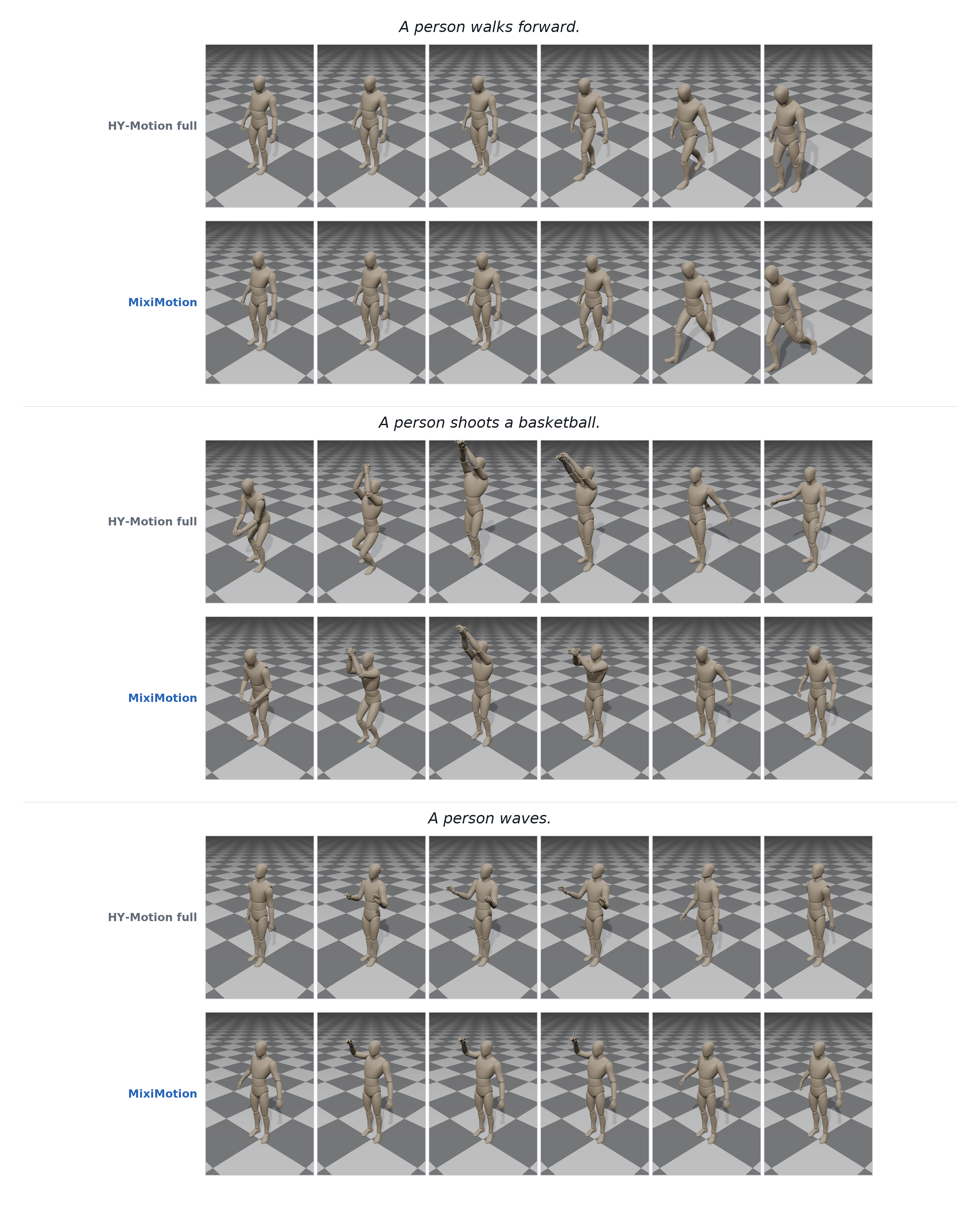
Selected successful clips under a shared renderer, camera, and lighting. These examples illustrate temporal progression and are not a random sample.
Comparison with Baselines
Compare MixiMotion with compact one- and few-step baselines on the same prompts. Cross-family clips keep native renderers.
| Prompt | MotionLCM-1 | MotionHiFlow | MixiMotion (Ours) | HY-Motion full |
|---|---|---|---|---|
| "A person walks forward." | ||||
| "A person shoots a basketball." |
Experimental Results
ViMoGen Semantic Alignment
MixiMotion versus 50-NFE HY-Motion-1.0 full is renderer-controlled. Other rows keep native renderers and are contextual. The paired MixiMotion−HY-full gap is \(-0.0055\) with 95% CI \([-0.0121, 0.0011]\).
| Method | NFE ↓ | Daily ↑ | Fit. ↑ | Game ↑ | Loco. ↑ | Social ↑ | Sports ↑ | Overall ↑ |
|---|---|---|---|---|---|---|---|---|
| One-step and few-step | ||||||||
| MixiMotion (Ours) | 1 | 0.9009 | 0.7487 | 0.9205 | 0.9757 | 0.9332 | 0.8430 | 0.8802 |
| MotionLCM-1 | 1 | 0.8065 | 0.7213 | 0.8977 | 0.9621 | 0.9211 | 0.7807 | 0.8415 |
| MotionHiFlow | 14 | 0.8617 | 0.7717 | 0.9187 | 0.9689 | 0.9452 | 0.8274 | 0.8764 |
| Multi-step reference | ||||||||
| HY-Motion-1.0 full | 50 | 0.9075 | 0.7613 | 0.9215 | 0.9757 | 0.9419 | 0.8451 | 0.8856 |
| MLD | 50 | 0.8112 | 0.7079 | 0.8959 | 0.9582 | 0.9310 | 0.7796 | 0.8398 |
| MDM | 50 | 0.8196 | 0.7235 | 0.8648 | 0.9504 | 0.9266 | 0.7516 | 0.8331 |
Efficiency (RTX 5090, BF16)
| Method | Params (M) ↓ | NFE ↓ | Gen. ms ↓ | E2E ms ↓ |
|---|---|---|---|---|
| HY-Motion-1.0 full | 1042.9 | 50 | 829.58 | 968.25 |
| MixiMotion (Ours) | 460.0 | 1 | 9.30 | 143.55 |
| MotionHiFlow | 33.1 | 14 | 77.32 | 83.80 |
| MotionLCM-1 | 26.5 | 1 | 3.04 | 13.94 |
The \(89.2\times\) generation speedup is only versus 50-NFE HY-Motion full under matched-family timing. MotionLCM-1 remains smaller and faster.
Limitations and Future Work
Limitations
MixiMotion generates fixed 120-frame clips. SSAE is a same-family protocol with one VLM judge; only the HY-Motion comparison controls the renderer. The student reuses the teacher backbone, so this is not an architecture result. MBench generalizability (0.24 vs. 0.40 for HY-Motion full) shows that one-step set matching does not recover the teacher distribution. Staged training is non-monotonic on SSAE and skating.
Future Work
Independently sourced prompts, a common cross-family renderer, component ablations on the filtered checkpoint, and variable-length generation would test whether the one-step quality–latency trade-off generalizes beyond this teacher family.
Citation
@inproceedings{dinh2026miximotion,
  title={MixiMotion: One-Step Text-to-Motion Generation via Asymmetric Set Distillation},
  author={Hung Dinh and Binh Mai and Tran Quoc Bao Le and Lam Nguyen and Cong Tran},
  booktitle={SOICT},
  year={2026}
}